
Adaptive Cruise Control (ACC) Calibration

Adaptive cruise control (ACC — Adaptive Cruise Control) is a modern driver-assistance system that improves on traditional cruise control by using smart sensors and cameras to automatically adjust your vehicle’s driving speed.

This technology helps maintain a safe distance from the vehicle ahead, ensuring smoother and safer travel. As cars become increasingly automated, ACC systems are becoming standard, which means adaptive cruise control (ACC) calibration has become an integral part of vehicle maintenance.

Why calibration matters for safety

Correct adaptive cruise control (ACC) calibration is crucial to guarantee that the system works exactly as the manufacturer intended. A misaligned sensor angle or an incorrectly performed calibration can lead to faulty data readings. This directly affects the car’s ability to detect other vehicles in time and maintain a safe distance, which in turn seriously endangers road safety and makes the very existence of the system pointless.

It is important to understand that the adaptive cruise control (ACC) system, like any other mechanical or electronic part of your car, requires regular checks and technical supervision.

How does the calibration process work?

Calibration involves precisely aligning the radars, sensors, and cameras used by the ACC system to ensure that they analyze the surrounding environment flawlessly and correctly.

This process usually requires specific, expensive equipment and a high level of technical expertise. During calibration, qualified technicians carry out system diagnostics, sensor adjustment, and parameterization using special equipment to ensure correct adaptive cruise control (ACC) calibration.

When is adaptive cruise control (ACC) calibration needed?

There are several standard situations in which system setup is mandatory:

  • After body repair or an impact: even a minor collision, or removing and refitting the front bumper, usually changes the physical mounting angle of the front sensors and radars.
  • After wheel alignment: Adjusting the wheel alignment changes how the car sits relative to the road, which directly affects the front radar’s detection zone. For the system to work correctly, adaptive cruise control (ACC) calibration is required after an alignment.
  • When you notice malfunctions: in any situation where you notice odd behavior (e.g., unwarranted braking or acceleration) or inconsistency in the operation of the cruise control.

Signs that your ACC urgently needs servicing

It is important to recognize in time the symptoms indicating that the radars or cameras have shifted. The most common indicators are:

  • The system fails to identify vehicles ahead correctly and in time.
  • The car suddenly brakes unexpectedly and without reason, or accelerates too abruptly.
  • Warning lights come on in the instrument cluster, or error messages related to the cruise control appear.

Why choose professionals?

Although some car owners may be tempted to try to fix the problems themselves, it is strongly recommended to entrust this task to professionals. Specialized workshops have access to software and dedicated calibration rigs that guarantee adaptive cruise control (ACC) calibration is performed to strict factory standards. This ensures both maximum system performance and your safety.

Vejstikli.lv uses only the original Hella Gutmann CSC rig and the Hella Mega Macs X computer with original (OEM) software, guaranteeing that adaptive cruise control (ACC) calibration is performed in accordance with the manufacturer’s specifications.

Benefits of regular calibration

Timely and regular system maintenance offers a range of advantages:

  • Guarantees precise and predictable operation of the car’s assistance systems.
  • Significantly increases safety and driver comfort on the road.
  • Reduces the risk of sudden electronics failures in the future.

Calibration software

When choosing a workshop for ADAS calibration, make sure that only original (OEM) software is used. Since these systems are responsible for vehicle safety, calibration is of crucial importance.

Conclusion: Safety and efficiency come first

By including ACC calibration in your vehicle’s regular maintenance plan, you are making a direct investment in driving safety and vehicle efficiency. As adaptive technologies continue to develop rapidly, understanding their technical upkeep is becoming more important than ever. By taking care of sensor accuracy, you will ensure that your car remains a reliable and safe partner on every journey.

Source: https://adasyorkshire.co.uk/blog/why-adaptive-cruise-control-calibration-is-essential-for-your-vehicle

Radar Sensor Calibration

With the widespread adoption of driver-assistance systems (ADAS), automotive radars have come to play a crucial role in ensuring vehicle safety and smart driving. These radars are usually installed at the front and rear of the vehicle to scan the surrounding environment — identifying other vehicles, pedestrians, and obstacles. This makes it possible to provide features such as adaptive cruise control (ACC), blind-spot monitoring (BSM), and automatic emergency braking (AEB). However, to guarantee that the radar detects objects accurately and provides correct data, regular radar sensor calibration has become a critical necessity.

The fundamental purpose of radar operation is to ensure that the sensor’s detection angle and operating range precisely match the vehicle’s actual driving conditions. If the radar has shifted from its original position due to a collision, repair, or replacement, detection accuracy may decrease, which in turn affects the operation of ADAS functions. This not only creates potential safety risks but also significantly reduces driving comfort.

Radar sensor calibration is performed using specialized equipment and software. The calibration process mainly involves positioning calibration targets (reflectors), precisely determining the relative position of the vehicle and the target, and performing new parameterization. Through this process, the radar’s detection zone is brought into perfect alignment with the vehicle’s dynamics, giving the driver reliable assistance information.

As automotive technology continues to develop rapidly, smart radar sensor calibration and its importance are becoming ever more pronounced. Both car workshops and car manufacturers must pay increased attention to this process to guarantee vehicle safety and technological efficiency.

How automotive radars work

The automotive radar is one of the key sensors of advanced driver-assistance systems (ADAS). It analyzes the environment around the vehicle by emitting and receiving radio waves. Its basic operating principle consists of the following steps:

1. Emitting radio waves

The radar sensor emits high-frequency radio waves (usually millimeter waves in the 24 GHz or 77 GHz frequency bands) toward the target zone. These waves travel quickly through the air and, upon encountering an object, are reflected back.

2. Receiving the reflected signal

The sensor receives the signals reflected back from the object. These signals contain information about the target’s distance, relative speed, and position.

3. Processing and calculations

  • Distance: the distance to the object is calculated based on the time it takes the radio wave to reach the object and return.
  • Speed: using the Doppler effect, the radar can precisely measure the object’s relative speed.
  • Direction: by combining multiple signal receivers, the radar can determine the object’s azimuth (angular direction).

Different types of automotive radars and how they differ

Short-range radar (SRR)

  • Operating range: approximately 0.2 to 30 meters.
  • Main applications: blind-spot monitoring (BSM), parking assist, and lane-change assist.

Long-range radar (LRR)

  • Operating range: approximately 30 to 250 meters.
  • Main applications: adaptive cruise control (ACC), forward collision warning (FCW), and other safety systems.

Differences between radar and laser sensors

Compared with car cameras and LiDAR (laser scanning) systems, radar has the following advantages:

  • Operation in any weather conditions: lighting or conditions such as rain, snow, or fog do not significantly affect radar performance.
  • High penetration capability: it can pass through minor obstructions such as light fog or dirt.
  • Precise speed measurement: using the Doppler effect, radar can directly measure the target’s relative speed, whereas cameras and LiDAR must calculate it indirectly using algorithms.

The role of radar in ADAS systems

  • Forward collision warning (FCW): detects vehicles or obstacles ahead in real time and warns the driver.
  • Blind-spot monitoring (BSM): monitors the blind spots on both sides of the vehicle and warns the driver of potential danger.
  • Adaptive cruise control (ACC): maintains a safe distance from the vehicle ahead and automatically adjusts the driving speed.

Effective automotive radar operation is the foundation of modern vehicle safety and autonomous driving technology. However, this is only possible if precise radar sensor calibration has been performed, ensuring data reliability and the correct functioning of the entire system.

Why is radar sensor calibration so important?

Automotive radar calibration is critically important to guarantee vehicle safety and correct ADAS operation. Below are the main reasons why professional radar sensor calibration is necessary and how this plays out in practice:

1. Impact on driving safety

An uncalibrated or incorrectly configured radar can cause the following critical problems:

  • False alarms: the radar may mistakenly detect non-existent obstacles, triggering unnecessary warnings or sudden automatic braking that endangers other road users.
  • Missed hazards: the radar fails to accurately detect real obstacles or dangers, causing the ADAS system to malfunction and increasing the risk of a collision.
  • Reduced system reliability: calibration errors can cause the driver to lose confidence in the electronic systems, with the result that they stop relying on the ADAS driver-assistance systems.

2. Regulations and industry standards

In many countries and regions, the accuracy of ADAS functions is governed by strict legislation and industry standards. For example:

  • Euro NCAP: when assessing the safety of new vehicles, radar accuracy and functionality are included among the key indicators.
  • Regulatory requirements: If a sensor is not correctly adjusted, it can create not only safety risks but also legal liability for non-compliance with the manufacturer’s specifications and regulations.

3. Fixing problems after car repairs

  • After component replacement: replacing parts such as the bumper, front grille, or the radar sensor itself can affect the radar’s mounting angle, so a new radar sensor calibration is mandatory.
  • After body repair following a collision: the vehicle’s frame and sensor mounting points may be slightly misaligned. Calibration ensures the radar conforms to the original manufacturer’s (OEM) standards.
  • Regular maintenance: over time, vehicle vibrations, environmental factors, or even a wheel alignment can change the radar sensor’s position. Radar sensor calibration helps restore optimal performance.

When is radar sensor calibration needed?

Automotive radar setup is an essential step in ensuring the accuracy and reliability of the vehicle’s radar system. Timely radar sensor calibration is usually required in the following situations:

  • After body repair following a collision: Even minor collisions can cause the radar sensor to shift or become completely misaligned. Calibration ensures the sensor is correctly aligned with the vehicle’s dynamics and restores the accurate operation of ADAS functions.
  • After replacing vehicle components: When replacing car parts such as the bumper, front grille, or the sensor itself, calibration is mandatory, as the new parts can change the radar sensor’s physical position and detection angle.
  • When installing or updating an ADAS system: When installing or software-updating ADAS functions, radar sensor calibration is a crucial step for the new system to work correctly. This step helps align the radar sensors with other components, such as the cameras built into the windshield.
  • During regular maintenance: As part of regular vehicle servicing, this process helps ensure the sensors remain correctly aligned after prolonged use, compensating for minor shifts caused by vehicle vibrations.

The most common challenges in radar calibration

Radar calibration plays a crucial role in ensuring ADAS accuracy, but the process faces the following challenges:

  • High precision requirements: Radar adjustment requires extremely high precision, as even the smallest error can cause ADAS malfunctions (for example, errors in adaptive cruise control operation) or false alarms.
  • Equipment and costs: Professional radar calibration equipment is expensive, and small workshops may find it financially difficult to afford. Likewise, not all workshops are equipped with the latest calibration systems for servicing modern cars.
  • Technical complexity: This process requires skilled technicians with a good understanding of the vehicle’s ADAS systems in order to precisely follow the procedures specified by different manufacturers.

Radar calibration tools and equipment

For the process to be successful, specialized tools and equipment are needed to ensure precision and reliability.

The most common calibration equipment on the market

  • Static calibration systems: these use stationary calibration rigs, reflectors (targets), and other instruments to precisely align the radar sensors on a stationary car. Vejstikli.lv uses the original (OEM) Hella Gutmann CSC rig and software.
  • Dynamic calibration tools: these are used for calibration during real road test drives, adjusting the radar settings while the vehicle is in motion. Vejstikli.lv uses the Hella Mega Macs X computer with original (OEM) Hella software.

Calibration software

When choosing a workshop for ADAS calibration, make sure that only original (OEM) software is used. Since these systems are responsible for vehicle safety, calibration is of crucial importance.

Source: https://newsmartsafe.com/industry-news/car-radar-calibration

Static and Dynamic Calibration

ADAS systems in modern cars are becoming increasingly sophisticated, and precise adaptive cruise control (ACC) calibration is becoming ever more important. Before every repair, auto service managers face the question: which calibration method will need to be used? Static or dynamic calibration — and which method is more accurate?

The truth is that calibration technicians do not choose the calibration method themselves — it is determined by the vehicle manufacturer, and accordingly the calibration software tells technicians which calibration procedure must be used on a specific vehicle. Nevertheless, we would like to compare both calibration methods, their strengths and weaknesses.

What is ADAS calibration accuracy?

ADAS calibration accuracy determines how closely a vehicle’s sensors — especially the front camera and radars — are aligned with the manufacturer’s specifications. Precise adjustment ensures that systems such as:

  • Lane Keeping Assist (LKA)
  • Forward Collision Warning (FCW)
  • Automatic Emergency Braking (AEB)

operate within their intended parameters. Even minor sensor axis misalignments can cause delayed warnings or an incorrect system response. In cases such as adaptive cruise control (ACC) calibration, accuracy comes first so the car can correctly maintain its distance at high speed.

Static ADAS calibration: Accuracy analysis

Why does static calibration offer high accuracy?

Static calibration is performed in a controlled environment (on the service premises), using stands and targets specified by the original equipment manufacturer (OEM), fixed distances, and precise measurements. This level of control reduces the external variables that could affect sensor alignment.

Accuracy advantages:

  • Precise positioning of the stand and targets based on manufacturer data.
  • Stable lighting and consistent environmental conditions.
  • Repeatable and stable results across different vehicles.
  • Independence from road surface condition and weather.

Because of this accuracy, the static method is often considered the most reliable form of calibration, especially for modern camera-based ADAS systems.

Accuracy limitations

The effectiveness of the static method is closely tied to:

  • Proper preparation of the service environment.
  • A perfectly level floor.
  • Millimeter-precise placement of the calibration stands.

Incorrect stand setup can significantly reduce accuracy, even when the correct methodology is used.

Dynamic ADAS calibration: Accuracy analysis

How does the dynamic method achieve accuracy?

Dynamic calibration relies on data collected during real-world driving. The ADAS system self-learns, identifying on the road:

  • Lane markings.
  • Road edges and curbs.
  • Road signs.
  • The distance to vehicles driving ahead.

If road conditions fully meet the manufacturer’s (OEM) requirements, dynamic calibration can achieve high practical accuracy in real driving scenarios.

Accuracy limitations

The result of dynamic calibration is affected by:

  • Road quality and lane line visibility.
  • Traffic intensity and weather conditions (rain, snow, fog).
  • Driving speed and the duration of the test drive.
  • The stability of the sensor’s self-learning process.

Because of these variables, dynamic calibration is less controllable and harder to repeat than the static procedure.

Interesting fact: Even sun glare shining toward the camera can disrupt the dynamic calibration process…!

Static vs. dynamic calibration: Comparison

CriterionStatic calibrationDynamic calibration
Environmental controlVery highLow
RepeatabilityExcellentLimited
External influenceMinimalSignificant
Manufacturer (OEM) preferenceOften requiredDepends on the car model
Practical on-road effectivenessIndirectDirect
Overall accuracyHigherDepends on conditions

Which calibration method is more accurate?

From a purely technical standpoint, static calibration is generally more accurate, thanks to the controlled environment and the millimeter-precision setup in the workshop.

However, accuracy alone does not determine the choice of method. The final decision is dictated by the vehicle manufacturer’s (OEM) requirements:

  • Which method is mandatory for the specific model.
  • Whether both methods need to be performed in combination.

Many manufacturers require static calibration to be performed first in the workshop and the process to then be completed with dynamic calibration on the road, ensuring both baseline accuracy and validation of system operation in real traffic.

When can dynamic calibration alone be enough?

The dynamic method is acceptable and sufficient if:

  • The manufacturer has specified only dynamic calibration for the specific car model.
  • Road and weather conditions during the test drive perfectly meet the requirements.
  • The ADAS system’s algorithms are designed to rely primarily on recognizing real-world objects.

Even in these cases, the manufacturer’s test-drive guidelines must be strictly followed.

Best practice: Accuracy and compliance with standards

The most reliable approach is not choosing one method, but rather:

  • Precisely following the calibration procedure specified by the manufacturer (OEM).
  • Using professional, certified ADAS calibration equipment.
  • A full system operation check (diagnostics) after the process is complete.

This guarantees both technically precise execution and compliance with safety standards.

Conclusion

Although static ADAS calibration generally delivers higher technical accuracy thanks to its controlled environment, dynamic calibration plays a critical role in verifying system operation in real driving conditions. The most accurate and safest results are achieved when the methods are chosen strictly in accordance with the vehicle manufacturer’s specifications and, where necessary, combined within a single process. In overall sensor preparation, which also includes adaptive cruise control (ACC) calibration, knowing the strengths of both methods allows service centers to provide customers with maximum safety on the road.

Source: https://newsmartsafe.com/industry-news/static-dynamic-adas-calibration-which-is-more-accurate

Windshield Camera Calibration

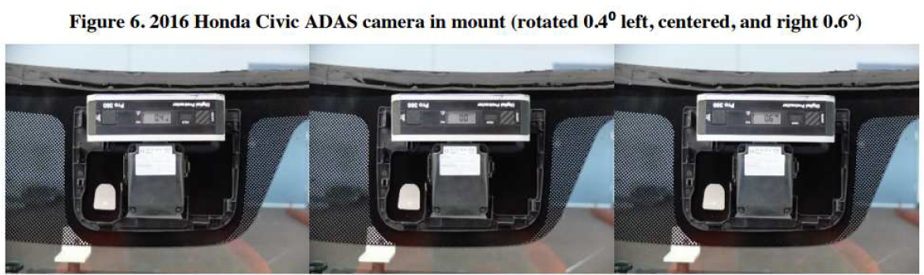
2016 Honda Civic ADAS windshield camera in its bracket (left – 0.4-degree misalignment, center – ideal position, right – 0.6-degree misalignment

Windshield camera calibration, ADAS calibration

Photo from: IIHS/HLDI

Most modern vehicles use a single ADAS camera positioned behind the windshield for safety purposes. Unlike radar systems, camera-based sensors do not by themselves receive direct information about object distance or relative speed – they capture a “flat” two-dimensional image.

To determine depth and distance, ADAS driver-assistance systems and their algorithms rely on specific real-world parameters. If these parameters change, the system’s operation is paralyzed, which is exactly why windshield camera calibration after any repair is a mandatory safety step.

How do mono cameras calculate distance and speed?

For mono cameras to accurately determine the relative distance and speed of the vehicle driving ahead, the algorithms use two basic methods:

  • The scale-based method (motion parallax): As we move, nearby objects visually change their size considerably faster than those in the distance. Driving on a highway, the car ahead slowly transforms from a small dot in the distance into a large object. If the system knows the car’s own speed, it can calculate the relative distance to the other object. If the image in the camera’s view grows too quickly, the windshield camera and the ADAS system register a collision risk and trigger a warning or automatic emergency braking.
  • The ground-based method: This algorithm relies on mathematical assumptions about fixed distances – the camera’s exact height above the ground and the tires’ contact point with the road. Knowing these values, the system can precisely calculate the distance to any other point on the road.

The operation of these camera system algorithms is entirely dependent on the camera height and angle specified by the manufacturer. These parameters are usually stored in the vehicle’s control unit at the end of the factory assembly line.

However, if the camera’s position changes (even minimally) — for example, after a collision or body repair —, all the mathematical calculations become incorrect. In such cases, professional windshield camera calibration is required to feed correct data into the system.

Study: How dangerous is a one-degree misalignment?

Recently, researchers analyzed how the effectiveness of camera-based automatic emergency braking (AEB — Automatic Emergency Braking) systems changes when the sensor is misaligned by just one degree in vertical tilt (up/down) or horizontal angle (left/right).

In real life, a one-degree misalignment is invisible to the naked eye – it means that one edge of the sensor in its housing has shifted forward or backward by just a millimeter or two. Yet the study’s results proved critical.

The researchers tested the maximum speed at which the AEB system could still safely slow the vehicle down to 20–30 km/h (the speed Euro NCAP considers a safe collision threshold at which the risk of serious injury is minimal).

Results with a moving target (the car ahead is braking):

  • Correctly adjusted camera: The AEB system works flawlessly, safely slowing the car even at initial speeds from 60 to 130 km/h.
  • 1-degree misalignment in vertical tilt: The AEB system fails completely (does not activate at all).
  • 1-degree misalignment in horizontal angle: System operation is seriously compromised, and it can only partially activate at low speed (up to 50 km/h).

Results with a stationary target (a fully stopped car ahead):

  • A one-degree misalignment in horizontal angle substantially reduced the effective braking speed threshold — down to driving at just 30 km/h. At higher speeds, the system could not react in time. A misalignment in vertical tilt in this scenario showed a slightly less critical, but still dangerous, drop in effectiveness.

These findings are also confirmed by a real-world study conducted by the US Insurance Institute for Highway Safety (IIHS). It documented a complete AEB system failure in a situation where the camera had been rotated by less than one degree and no recalibration was performed afterward.

Small changes — severe consequences

Everyone involved in the auto repair and collision industry needs to understand: when it comes to ADAS, minimal changes have enormous consequences. As a result of an impact, a sensor only needs to shift by 1 degree for the safety assistants to stop working correctly.

This is not irreversible – the sensor angles can be recalibrated. During the procedure, the control unit learns and stores the new physical values, fully restoring factory effectiveness. Specialists who work with ADAS diagnostics every day know that these new angle values appear on the calibration equipment’s screen once the calibration process has been successfully completed.

Conclusions: The absence of fault codes does not guarantee safety

If precise windshield camera calibration is not performed after body repair, changes to the chassis geometry, or glass replacement (even though the manufacturer clearly requires it in the instructions), the electronic ADAS safety systems will not work as intended.

The most dangerous part is that in most cases, no fault codes or warning indicators will appear on the car’s instrument panel. The car will “think” the sensor is working correctly and will keep making calculations based on incorrect angles. The absence of faults in diagnostics does not mean the ADAS sensor is ready for operation, and it does not guarantee safety.

Summary: Does a one-degree misalignment really affect safety? Yes, studies prove it unequivocally. Only professionally and timely performed ADAS system calibration guarantees that automatic braking will activate precisely in a critical situation.

  • jugla@vejstikli.lv
  • imanta@vejstikli.lv
  • +371 6756 2222
This site is registered on wpml.org as a development site. Switch to a production site key to remove this banner.